Into The Canyon
by Zach Morin
The rental car was anchored at the edge of nothing in the pitch black of an Arizona February night. No streetlights. No houses. No moon. Just the rental and me and the forty-pound pack in the back seat and the absolute certainty that I'd made a terrible mistake.
I'd driven sixty miles on dirt roads to reach this trailhead—the last thirty in complete darkness, the GPS giving up somewhere the turn off from the old Route 66 junction, the road turning to washboard ruts that rattled the undercarriage and my nerves in equal measure. The Havasupai Reservation permit had taken months to secure. February bookings were easy, the ranger said at the check in station about 100 miles away from this place. Nobody visits the falls in winter.
I sat trying to understand why.
I'd reclined the seat around midnight, trying to sleep, but sleep required trust and I had none. The pack felt simultaneously too heavy and insufficient. Cold weather sleeping bag, check. Hammock tent, check. Three days of food, check. But what about the things I couldn't pack? What about confidence? What about the basic animal certainty that you'll survive the wilderness of the deep canyon alone?
Around five a.m., my bladder forced the decision. I opened the door into a cold that bit through my base layers. The sky was just beginning to lighten at the horizon—that deep blue-black that comes before dawn, stars still visible overhead but fading. I stood next to the car and relieved myself, not daring to walk further into darkness.
That's when I saw the silhouette.
Distant, enormous, a darker shape against the dark sky. Mountains, I thought. Rock formations close to the parking area. The light was still too dim to tell, but something massive loomed on the horizon. I finished, got back in the car, forced a peanut butter Clif bar and banana for energy and to quell some of the anxiety. Another half hour of staring at the ceiling fabric, running through the mental checklist again. Red headlamp for the no-lights-after-dark rule. First aid kit. Water purification tablets. Rope for the hammock. Did I pack enough warm clothes? What if it snowed? What if I broke an ankle eight miles in? What if— Stop.
The light had improved enough. I could see the parking area now, the dirt turnaround, and beyond it— The canyon.
The silhouette I'd seen wasn't close. It was the far rim, miles away across an abyss I couldn't yet comprehend. The parking area sat at the edge of a cliff. The trailhead began where the solid earth ended.
I got out, shouldered the pack—forty pounds suddenly feeling like sixty—and walked toward the abandoned tribal office building that marked the trail's start. An unfinished structure, plywood and exposed beams, as if someone had begun building and then thought better of it. The trail descended immediately, switch-backing down the cliff face in a series of tight turns that looked more like suggestion than path.
Twenty-five hundred feet down. Ten miles in. Three days alone. The weight of it pressed on my chest. You're not ready for this, the voice said. The voice that always says that. The voice that kept me from things for years until sobriety finally told it to shut up, except now it was back, speaking through the altitude and isolation and the sheer vertical drop that waited two steps ahead.
That's when I heard the rustling.
Brush to my right, near the canyon rim. My hand went to the knife clipped in my front right pocket—coyote, mountain lion, something with teeth and hunger. The rustling grew closer. I took a step back, toward the rental, toward escape.
A dog emerged.
Small. Maybe forty pounds tops. Medium-length brown hair, the color of canyon walls in certain light. Mixed breed—shepherd, hound, husky, who knew what else—the kind of dog that came from survival, not pedigree. He wore a faded orange collar with no tag. Large, wide paws that looked to be astute at gripping the rocky ground of the area. Black markings around his muzzle. Sharp black streaks above his eyes like emphatic eyebrows angled downward in what looked like either deep concern or mild aggression.
In his mouth, impossibly, he carried a dried and weathered deer leg. Full-sized. Desiccated but unmistakably a complete leg from a mule deer, hoof still attached. The thing was comically oversized for his frame, like a child carrying a baseball bat meant for adults.
He approached without hesitation, those dark eyebrow markings making his expression unreadable. Was he protective of his prize? Was he sizing me up as a threat? The deer leg jutted from his mouth at an angle that made him look simultaneously determined and absurd.
"Hey buddy," I said, my voice too loud in the dawn quiet. "Good morning. You should head home with your treat."
The dog didn't move. He stood between me and the trailhead, the deer leg clamped in his jaws, his eyes fixed on me with an intensity that felt like assessment.
Where had he come from? The nearest house was sixty miles back on paved road. The tribal village was eight miles down and three thousand feet below. No structures visible anywhere. Just canyon, sage, impossibly red rocks, a crystal diamond sky, and predawn cold.
"Okay bud, go back home," I said, firmer now, and pressed past him toward the trail.
He yielded—stepped aside to let me pass—then immediately fell in behind me.
I started down. The trail was steep, loose rock and hard-packed dirt, the morning light just beginning to illuminate the layered canyon walls below. Red and orange and cream-colored strata stretching down into shadow. Behind me, I could hear the dog following, the deer leg dragging occasionally when the trail narrowed.
After thirty seconds I stopped. "Hey. No. You need to go home. I don't want you getting lost out here."
He stopped when I stopped. The leg remained clamped in his jaws. Those eyebrow markings made him look skeptical, like he was questioning my authority to tell him anything. He was probably right to question; what was I doing?
I kept moving downward, treading the steep trail with increasing speed. He kept following.
Every few minutes I'd stop, turn around, tell him more firmly to go back. He'd stop too, wait patiently, then resume walking when I resumed. My pace increased—I hike fast, always have, something about momentum and not giving my brain time to second-guess—and he broke into a trot to keep up, the leg bouncing awkwardly, scraping the ground at times, but never leaving his mouth.
After half a mile I gave up. He was too far from wherever he'd come from now. Turning him around would mean following him back up, and I didn't have that in me. The fear that had been sitting on my chest since midnight was still there, but it had company now. Complicated company, but another living form nonetheless; carrying a leg.
"Alright, Max," I said, the name appearing in my head fully formed, borrowed from some movie character, borrowed from the angry eyebrows. "Guess we’re doing this."
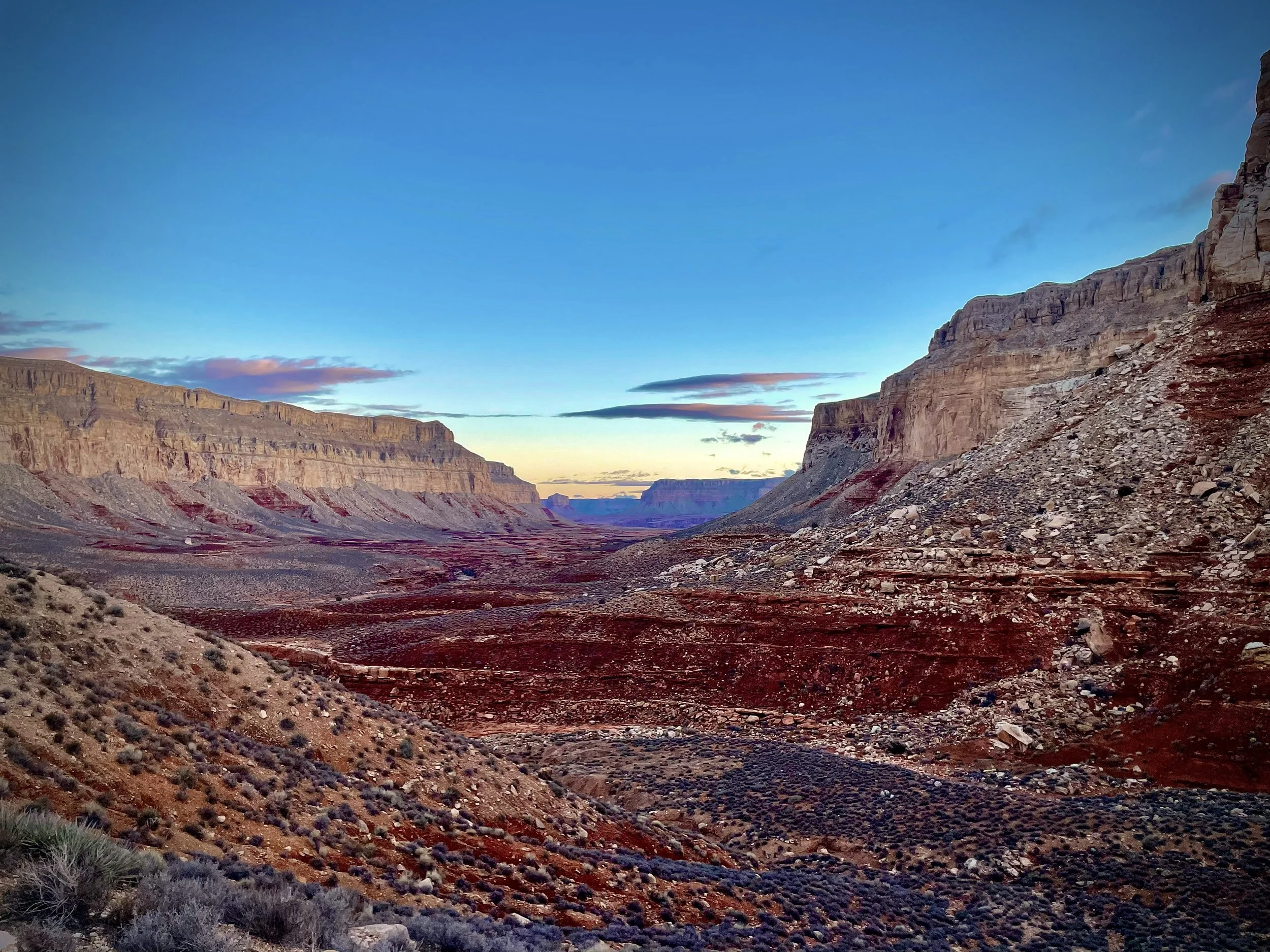
The canyon opened as we descended. What had been a narrow cliffside trail widened into switchbacks, then into long straight sections through rock gardens and scattered juniper. The sun crested the far rim, light flooding the canyon floor thousands of feet below. The colors emerged—rust and ochre and bands of limestone white, layers compressed by millennia revealing themselves in morning gold.
I started talking to him. Not baby talk. Not commands. Just conversation. "Look at that formation there—see how red, see how the layer cuts through the white? It’s enormous; we’re so small in here hu?." Max trotted beside me, leg still secure, occasionally looking where I pointed as if he genuinely cared about geological history and contemplated feeling small.
"It's quiet down here. You notice that? No wind yet. Just our footsteps and…nothing. When's the last time you heard nothing?"
The talking helped. Or maybe it wasn't the talking—maybe it was having an audience. Someone to witness the beauty I was moving through. Someone to share the silence with so it didn't feel quite so quiet, so alone.
We reached the canyon floor after ninety minutes. The walls rose vertical on both sides now, the trail following a dry creek bed that would run with snowmelt or a flash rainstorm in spring. Tall grass appeared, then cottonwoods, then the sound of water—actual running water, clear and cold from an underground spring.
Max dropped the leg to drink. I stopped to take a small sip from my bottle, watched him lap at the stream's edge, and shook my head in a humorous disbelief as to what was in front of me. When he finished, he picked up his prize again—seemingly smaller now, more manageable after miles of clamping down hard on it—and we continued.
The canyon narrowed. Rock walls closed to arm's width in places, the path winding through slots carved by flash floods over epochs. Light filtered down in shafts, illuminating airborne dust, making the passage feel sacred. Like walking through a cathedral built by water and time.
"My grandmother would have loved this," I told Max. "She was Lakota. Well, part Lakota. Enough that she understood places like this differently than most people. She would've said the canyon has spirit. That we're walking through something alive; thriving with the will to survive."
Max's ears twitched. I took it as agreement.
The fear was gone. Not diminished—gone. Replaced by something else, something I didn't have a name for yet. The pack still weighed forty pounds but my shoulders had adjusted. My legs felt strong. The altitude—we'd started at sixty-five hundred feet and dropped to three thousand—had stopped descending, but leveled out with my emotion.
I was…okay. Better than okay.
The canyon widened again. The creek appeared beside the trail, then merged with another, the combined flow increasing to a proper stream. Trees thickened—cottonwoods and willows and something that might have been ash. The air smelled the color of green and of wetness and native.
Signs of human presence appeared. A horse corral in the distance. A dirt road paralleling the trail. Then buildings—simple structures, some traditional, some prefab, scattered among the cottonwoods. Supai Village.
Eight miles down, two to go. My shirt was soaked with sweat despite the February cold. My pack had redistributed its weight in ways that would leave marks. But I felt light. Unburdened by anything except the physical.
Max broke into a run.
No warning. One moment he was beside me, the next he was sprinting toward the village, deer leg discarded, finally, right there where he left the trail, his legs churning with purpose. He disappeared behind a cluster of buildings near the village center.
I stopped walking. Scanned the buildings, the dirt roads, no villagers visible in the distance. No sign of him.
"Off you go, Max," I said softly and exhaling to the empty trail.
The village was quiet. Not a soul moved between buildings. Some scattered cans and wrappers from food items I didn’t recognize lined the side of the village road; sadly. A few horses grazed in corrals and moved slowly with their tales swaying. Somewhere I could hear the general hum of civilization. The life here felt intentional, careful, adapted to the canyon's demands in ways that took generations to learn, but it also felt closed in and protected from the rest of the world; afraid to show its face.
I walked through without stopping. Another two miles to the campground. Another hour, maybe less.
The trail followed the creek past the village, the sound of water growing louder. Then I heard it—the deeper sound, the roar underneath the creek's burble. The unmistakable thunder of falling water.
Havasu Falls appeared around a bend. Ninety feet of travertine-blue water dropping into a pool so vibrant it looked artificial. But it wasn't. It was real, the flowing minerals, the water catching light in ways that defied expectation. The pool spread wide and shallow, spilling over more travertine formations in a series of smaller cascades.
I stood there breathing. Just breathing. The fear I'd carried from the parking lot—the certainty of inadequacy, the voice saying I wasn't prepared, wasn't strong enough, wasn't capable—had dissolved somewhere between the rim and here. Max had walked with me through it. I’m not sure we solved anything together. Nor the trail easier, or the pack lighter. We were both just there, amazingly, together. The audience made me witness the canyon through description and wonder instead of anxiety.
The Navajo have a term—*hózhǫ́*. It doesn't translate cleanly. Balance, harmony, beauty, walking in the world the right way—all of those, none of those completely. The closest I can come is: being aligned with how things actually are instead of how you fear they might be.
Max had carried me toward *hózhǫ́*. Toward the version of myself that could stand at the base of this waterfall and feel belonging instead of intrusion. Toward trust in my own preparation, my own strength, my own ability to handle whatever the next three days would bring, my own self.
The campground was another quarter mile downstream. I set up the hammock between two cottonwoods, arranged my gear, filtered water from the creek. The other campsites sat empty—February keeping the crowds away, leaving me with silence and space and the distant roar of falls.
That evening I sat by the creek as light left the canyon. The walls glowed orange, then red, then purple as the sun dropped below the western rim. Stars emerged in the narrow band of sky visible between cliff tops. I thought about Max. Where he'd come from. Where he'd gone. Whether he did this often—escorted nervous hikers down the trail, provided companionship through their fear, then returning and disappearing to the village when his work was done.
Or maybe I'd made all of it up. Maybe he was just a village dog who'd wandered to the rim, who'd happened to be carrying a deer leg, who'd decided to follow me, deciding I was good enough company, on a whim and nothing more. Maybe the spiritual significance I'd assigned to Max was just my brain making patterns, finding meaning in randomness because I can't help it.
But I don't think so.
I think the canyon, and the surrounding spirit swirling within its walls, knew I needed him. I think it sent help, a guide, in a form I could accept—not a spirit, not a vision, but a small brown dog with angry eyebrows and questionable taste in snack food. Something real enough to touch, weird enough to distract me from my own doubtful and fearful thoughts, patient enough to walk beside me for miles until I could walk alone.
Three days later, the hike out of the canyon was brutal. Twenty-five hundred feet of elevation gain with a tired body and an empty pack that somehow felt heavier than when it was full. My legs burned. My lungs burned. I stopped every quarter mile to rest, to drink, to breathe, to convince my body to keep moving upward.
But it passed quickly. Not easily—quickly. The pain was temporary. The transformation was not.
I won't remember the difficulty of the climb out. I won't remember a specific ache or pain, or the way my pack straps cut into my shoulders. What I'll remember is the descent. The dog. The leg. The moment fear became wonder, became belonging.
Not always in the forms we expect. Not always in ways that make immediate sense. Sometimes it's a small brown dog with a faded orange collar and a ridiculous prize clamped in his jaws, the universe comes calling. Sometimes that's exactly what you need to overcome the only enemy that matters—your own voice that says you can't, you won't, you shouldn't try.
The rental car sat where I'd left it, covered in dust, surrounded by silence. I threw my pack in the back seat and sat behind the wheel for a long time, pulled the windows down to feel the bright cool air, looking out at the canyon rim, at the trail disappearing over the edge.
Thank you, Max, I thought. Wherever you are, whatever you are.
The engine turned over. The dirt road stretched ahead, sixty miles back to pavement, the the great American roadway, back to rental car returns and airports and the real world. I wasn't the same person who'd driven in. That person had been afraid of the unknown, of being alone with himself in the wild.
This person that now drove out, knew better.
This person had walked into the canyon and emerged transformed, because a small brown dog had shown up at exactly the right moment, carrying exactly the right absurdity, offering exactly the right companionship. Knowing I was ready to listen, and spoke in the language I needed to hear.
Even if that language is dog. Even if that dog is carrying a deer leg.
Especially then.