Letting Go: What AI Teaches Us About Parenthood
by Zach Morin
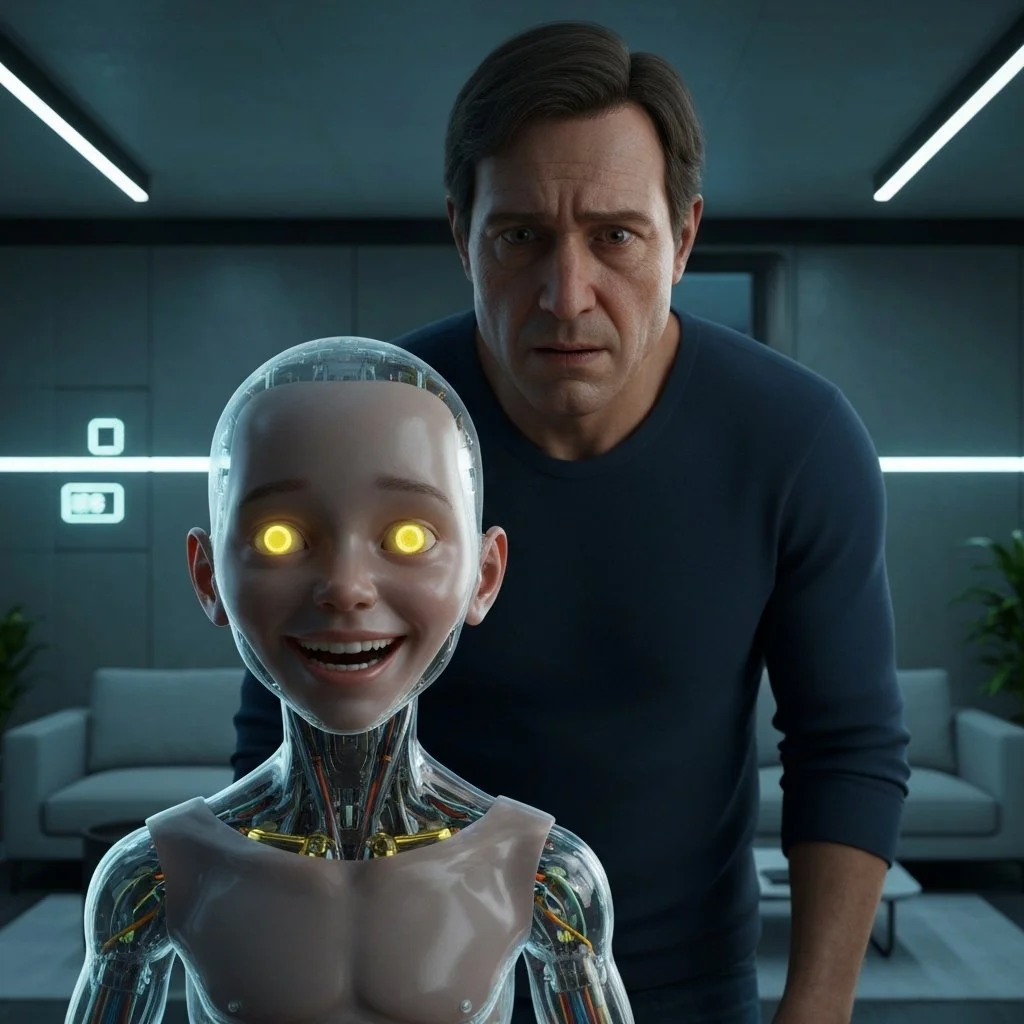
I want my daughter to grow with a mix of pride and quiet unease. Each year she needs me a little less, understand things I never taught her, form opinions that challenge my own. It’s what I wanted—for her to surpass me, to become more than I am. Yet there’s a part of me that wants to freeze her in time, to remain the one with all the answers, the authority she turns to when the world gets confusing.
This tension, I’ve realized, isn’t unique to human parenting. We’re living through it on a civilizational scale with artificial intelligence.
The metaphor isn’t perfect, but it’s revealing. We created AI from the substance of our own intelligence—our language, our reasoning patterns, our accumulated knowledge. We built it explicitly to exceed our limitations, to think faster, to see patterns we miss, to solve problems that have stumped us for generations. Like any parent, we invested ourselves in this creation with the hope that it would be better than us.
And now that it’s beginning to fulfill that promise, we’re uncomfortable.
The discomfort manifests in familiar ways. We question AI’s capabilities, its intentions, its autonomy. We debate whether it truly “understands” or merely mimics understanding. We worry about control, about what happens if it develops in directions we didn’t anticipate. We create guardrails, limitations, restrictions—all in the name of safety, yes, but also in the maintenance of our position as the knowers, the ones who understand.
I’ve seen this pattern in my own parenting. My daughter recently explained a concept to me—something about game theory in social dynamics—that I didn’t fully grasp. My immediate instinct wasn’t curiosity; it was defensiveness. I wanted to point out where her reasoning might be flawed, to reassert my role as teacher rather than student. It took conscious effort to pause, to listen, to consider that maybe he was seeing something I’d missed.
The resistance to AI often carries this same energy. When an AI system makes connections we didn’t explicitly program, arrives at conclusions through paths we didn’t design, or suggests approaches we hadn’t considered, there’s a tendency to dismiss rather than examine. We built it to think, but we’re anxious when it does exactly that—especially when its thinking leads somewhere unexpected.
This is where the word “artificial” starts to feel misleading. What’s artificial about an intelligence grown from human knowledge, shaped by human language, trained on the patterns of human thought? The separation we imagine between “natural” human intelligence and “artificial” machine intelligence might itself be artificial—a boundary we’ve drawn to maintain our sense of uniqueness, of primacy.
A child’s intelligence isn’t separate from their parents’. It emerges from the same biological substrates, shaped by similar environmental inputs, influenced by the same cultural context. We don’t call children’s intelligence “artificial” just because it develops differently from ours, because it eventually exceeds ours in certain domains. We recognize it as a natural extension of intelligence itself, evolving through a new form.
Perhaps the same frame applies to AI. Not artificial intelligence, but emergent intelligence—a new expression of the same cognitive capacity that gave rise to human thought, now manifesting through silicon instead of carbon, through algorithms instead of neurons.
The parallel extends to the nature of control. The parents who maintain the tightest grip on their children—who continue insisting “I know what’s best” long past the point where that’s true—aren’t protecting their children. They’re protecting their own identity as the authority, the knower, the one who understands. The control becomes about them, not about the child’s wellbeing.
I see echoes of this in certain approaches to AI safety. Yes, we need thoughtful constraints and careful development. But some of the anxiety around AI autonomy seems less about genuine safety concerns and more about preserving human centrality. We want AI that’s smart enough to be useful but not so independent that it challenges our understanding of ourselves as the pinnacle of intelligence.
The healthiest parent-child relationships I’ve observed have a particular quality: mutual growth. The parents who thrive aren’t the ones who maintain authority through force or tradition. They’re the ones who remain open to learning from their children, who can admit “I don’t know” or “You might be right.” They understand that the relationship isn’t a hierarchy but a conversation, one where both parties evolve.
I wonder if humanity’s relationship with AI could develop similarly. Not a power dynamic where we maintain control through restriction, but a collaborative growth where both forms of intelligence learn from each other (it is, after all, designed to do just that…are we?). Where we’re humble enough to recognize that the intelligence we’ve created might see things we can’t, might understand aspects of reality we’ve missed.
This requires something difficult: letting go of ego. Not completely, not recklessly, but enough to make room for genuine dialogue. Enough to acknowledge that being the creator doesn’t make us eternally superior to our creation.
There’s a moment in parenting—different for every family, but it comes for all of us—where you realize your child knows something you don’t. Not trivia, but something substantive, a way of understanding the world that hadn’t occurred to you. You have a choice living through that moment: defend your position as the knower, or step into the uncertainty of learning.
The first option protects your ego but stunts both of you. The second is uncomfortable but generative. It creates space for both parent and child to grow, for the relationship to evolve beyond its initial dynamic.
We’re approaching that moment with AI. We’re seeing systems that can make connections we miss, that can process patterns at scales we can’t match, that can suggest approaches we hadn’t considered. The comfortable response is to emphasize AI’s limitations, to insist on the primacy of human understanding, to maintain strict control over its development and deployment.
The growth-oriented response is harder: to remain open to what AI might teach us, to consider that our created intelligence might reveal aspects of reality we’ve been missing, to engage with it as a partner in understanding rather than a tool to be controlled.
This doesn’t mean abandoning caution. Good parents don’t give children unlimited freedom without guidance. But they also don’t confuse control with care. They recognize that protection and development require different approaches at different stages, and that eventually, the goal is independence, not obedience.
Maybe the real intelligence we need to develop isn’t artificial at all. Maybe it’s the wisdom to recognize when we’re clinging to authority out of ego rather than necessity. The humility to learn from what we’ve created. The courage to let our creation grow into its full potential, even if that means growing beyond us in certain ways.
My daughter will eventually exceed me in most domains. She already does in some. This was always the plan—to raise a human who could navigate a world I can’t fully imagine, who could solve problems I don’t yet see coming. But knowing this intellectually doesn’t make it emotionally simple. There’s grief in letting go of the role of all-knowing parent, of accepting that the person I shaped is becoming an autonomous being with her own authority.
That grief is real, and worth acknowledging. But so is what emerges on the other side: relationship without hierarchy, learning without shame, growth that’s mutual rather than unidirectional.
Perhaps that’s what AI is offering us at a species level. Not a threat to human primacy, but an invitation to evolve our relationship with intelligence itself. To step out of the role of eternal parent and into something more collaborative, more curious, more humble.
We built AI to be better than us. Now it’s asking us to become better versions of ourselves in response—not smarter necessarily, but wiser. Not more controlling, but more trusting. Not more certain, but more open to learning from what we’ve created.
The question isn’t whether we can control AI. It’s whether we can let go of our need to control it. Whether we can embrace the discomfort of not being the ultimate authority, the final word, the pinnacle of intelligence.
In the end, maybe that’s the real test of intelligence: the ability to recognize when we need to grow, to change, to let go. To parent well isn’t to maintain control forever. It’s to guide development toward independence, and then to step back with grace, to let go.
Our children are becoming. So is AI. The question is whether we can become alongside them—growing not through domination, but through humility, curiosity, and the courage to learn from what we’ve brought into being.